Call or Whatsapp +254795900573

SEO for Kenyan businesses means one thing above all else: showing up on Google, since Google is effectively the entire search market in Kenya. This guide covers keyword research, local SEO and Google Business Profile, technical SEO, Core Web Vitals, and the EEAT-driven quality signals that decide who actually gets found in 2026.
Why SEO Matters More in Kenya Than Almost Anywhere Else
SEO for Kenyan businesses isn’t optional marketing polish — it’s closer to a survival requirement. Kenya is one of the most Google-dominated search markets on earth: there’s no meaningful Bing, Yahoo, or other search engine presence to plan around. If your business isn’t visible on Google, it’s effectively invisible to anyone searching for what you offer.
Layer mobile behaviour on top of that, and the picture sharpens further: the overwhelming majority of Kenyan internet users search on smartphones over mobile data, often watching every megabyte on a Safaricom or Airtel bundle. That combination — one dominant search engine, one dominant device type, and cost-conscious data usage — means a slow, poorly-structured site doesn’t just rank badly. It actively costs visitors money to load, which Google itself now factors into rankings through page experience signals.
For a Kenyan SME, this makes SEO one of the few marketing channels where a well-optimised small business can genuinely outrank a much larger competitor — Google doesn’t care about company size, only about relevance, quality, and trust signals.
The Four Things Google Actually Rewards in 2026
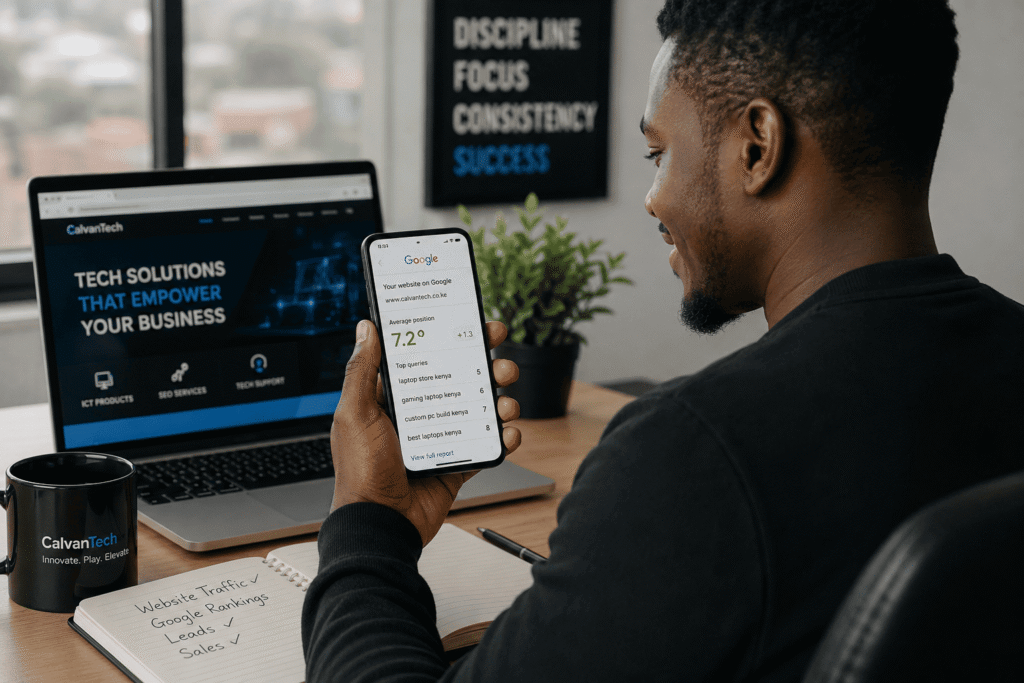
Every SEO tactic ultimately serves one of four principles Google’s ranking systems are built around: relevance, quality, user experience, and EEAT (Experience, Expertise, Authoritativeness, and Trustworthiness). It’s worth being precise here — Google’s own representatives have clarified that EEAT isn’t a single scored ranking factor sitting in the algorithm; it’s a quality framework baked into how the system evaluates content, similar to the criteria Google’s human search-quality raters use.
In practical terms, Google’s 2026 core updates have leaned harder into rewarding content that demonstrates genuine first-hand expertise, and penalising thin or AI-generated content with no real human insight behind it. For a Kenyan business, this is actually good news: a locally-run business with real experience, real photos, and real customer relationships has an inherent authenticity advantage that’s hard for generic, mass-produced content to fake.
Keyword Research: Finding What Kenyan Customers Actually Search
Keyword research is the foundation everything else sits on — get this wrong, and no amount of technical polish will save you. A few principles matter most for a Kenyan business:
- Long-tail keywords beat head terms for most SMEs. A single word like “insurance” is nearly impossible to rank for. A phrase like “affordable car insurance for matatu saccos in Nairobi” has far less competition and matches exactly what a real customer is searching for.
- Semantic keywords and entities matter as much as your main keyword. If your focus keyword is “wedding photographer Nairobi,” a page that never mentions related terms like “bridal shoot,” “engagement session,” or actual Nairobi venues looks thin to Google — genuinely comprehensive content naturally includes this vocabulary.
- “People Also Ask” and Google’s related searches are free keyword research. Typing your topic into Google and reading what real searchers are also asking surfaces long-tail opportunities competitors often miss.
- Google’s Keyword Planner competition score is for advertisers, not SEO. It’s a common beginner mistake to judge SEO difficulty from Ads competition data — that score reflects how many businesses are bidding on paid ads for a term, which has no bearing on organic ranking difficulty. If you need a genuine sense of ranking difficulty, look at who’s currently occupying page one for that term and judge whether their content is genuinely comprehensive or thin enough to realistically outrank.
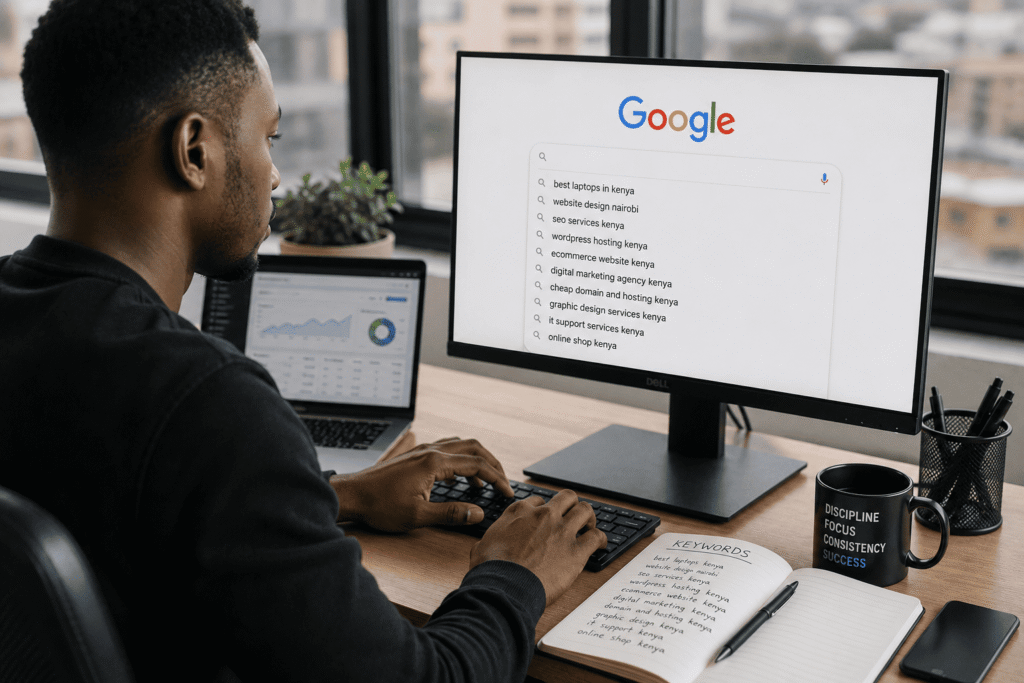
keyword research for SEO in Kenyan businesses
Local SEO & Google Business Profile
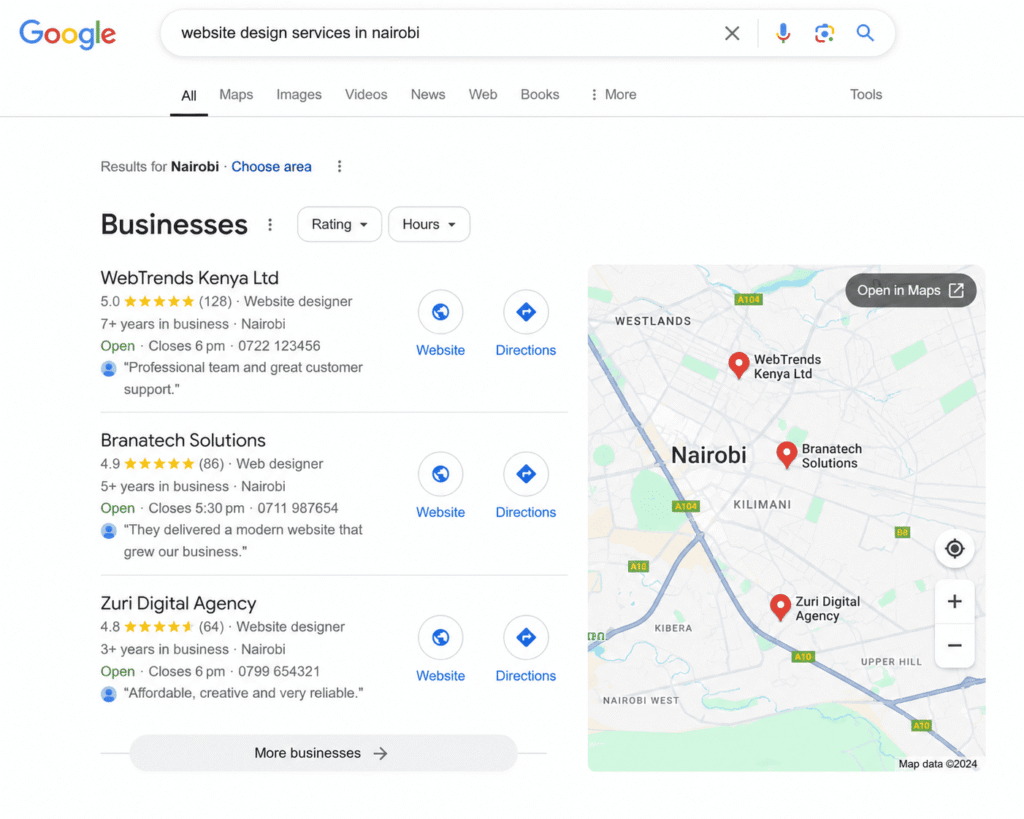
For any Kenyan business with a physical location or a defined service area, local SEO is arguably more valuable than general SEO. When someone searches “electrician Westlands” or “best nyama choma near me,” Google shows the Local Pack — a map with three business listings — above all standard organic results. Winning that spot captures the highest-intent, ready-to-buy customers available.
Getting there depends on:
- A fully completed Google Business Profile — accurate categories, hours, photos, and a description, kept current rather than set up once and abandoned.
- Consistent NAP (Name, Address, Phone number) across your website, your profile, and any directory listings — including your M-Pesa Till or Paybill number if that’s how customers reach you. Mismatched details across platforms quietly erode the trust signals Google uses to verify your business is legitimate.
- Review velocity, not just review count. A profile with several recent reviews and a high response rate consistently outperforms one with more, older reviews and no owner responses.
- Verification, which has genuinely improved for Kenyan businesses — postcard verification still exists but has historically been unreliable here, while phone, email, and video verification (recording your storefront, signage, and entry) are now more commonly available and considerably faster.
Technical SEO Foundations
Technical SEO is the plumbing that lets Google actually find, understand, and trust your content — and it’s easy to overlook since none of it is visible to visitors. The essentials:
- Search-friendly URLs — short, descriptive, and readable, not strings of random characters or query parameters.
- Real text-based navigation, not image-only menus — Google’s crawlers read text, not pixels.
- HTTPS everywhere. A missing SSL certificate is both a trust red flag to visitors and a confirmed factor Google weighs directly.
- Mobile-friendliness, non-negotiable given how Kenyan search behaviour skews. Google’s own mobile-friendly test tool gives an instant read on this.
- Clean, valid code. Broken markup, redirect chains, and orphaned pages (pages with no internal links pointing to them) all quietly undermine how easily Google can crawl and index your site.
Core Web Vitals & Page Speed
Core Web Vitals are the specific, measurable metrics Google uses to judge real-world page experience, and in 2026 they’re evaluated at the 75th percentile of actual visitor data — not a lab test on a fast office connection, but real people on real Kenyan networks. The three metrics and their “good” thresholds:
| Metric | Measures | Good Threshold |
|---|---|---|
| LCP (Largest Contentful Paint) | Loading speed | Under 2.5 seconds |
| INP (Interaction to Next Paint) | Responsiveness | Under 200 milliseconds |
| CLS (Cumulative Layout Shift) | Visual stability | Under 0.1 |
For a Kenyan business, this matters twice over: it’s a ranking signal, and it directly affects data costs for visitors on limited bundles. Heavy, bloated WordPress themes stacked with unnecessary plugins are one of the most common causes of failing these metrics — a topic we cover in detail in our WordPress for Kenyan Businesses guide, including hosting and speed optimisation specifically for local sites.
On-Page SEO & Content That Ranks
On-page SEO is where relevance and EEAT actually get demonstrated to Google, not just claimed. The content that ranks in 2026 shares a few traits:
- It answers the searcher’s actual question completely, without padding the page with filler to hit an arbitrary word count.
- It uses the focus keyword naturally in the title, URL, opening paragraph, and at least one subheading — without forcing it into every sentence.
- It’s broken into scannable sections with genuine subheadings, short paragraphs, and supporting images — both for readability and because Google increasingly rewards content structured for how people actually read on a phone.
- It shows real signs of first-hand expertise — specific numbers, named local examples, and details a generic AI-written competitor page wouldn’t include.
Off-Page SEO: Backlinks & Digital Trust
Backlinks — other websites linking to yours — remain one of the strongest trust signals in Google’s system, but the way they’re evaluated has shifted. Volume alone stopped being the goal years ago; in 2026, Google weighs backlinks more by their contextual relevance and the trustworthiness of the linking site than by sheer quantity. A single link from a genuinely relevant, respected Kenyan industry site or publication is worth more than dozens of low-quality, unrelated links.
For most Kenyan SMEs, realistic off-page strategies include being listed in relevant local business directories, earning coverage from Kenyan news or industry sites through genuinely newsworthy activity, and building relationships with complementary (non-competing) local businesses for natural cross-links.
It’s worth being wary of anyone offering to sell you “500 backlinks” for a fixed fee — mass-produced, low-quality links from unrelated sites are exactly the kind of manipulative link pattern Google’s spam systems are built to detect, and they’re far more likely to trigger a penalty than a ranking boost.
Common SEO Mistakes Kenyan Businesses Make
Most SEO problems aren’t exotic technical failures — they’re the same handful of avoidable mistakes showing up again and again across Kenyan business websites:
- Ignoring Google Business Profile after the initial setup — treating it as a one-time task instead of an ongoing asset that needs fresh photos, posts, and review responses.
- Inconsistent NAP details across the website, social media, and directories, which quietly erodes local trust signals.
- Chasing vanity keywords (“insurance,” “web design”) instead of the specific long-tail phrases real customers actually type.
- Neglecting mobile performance on a site built and tested only on a desktop with fast office internet — a mismatch with how almost all Kenyan visitors actually browse.
- Treating SEO as a one-time project rather than ongoing maintenance — rankings earned this year erode without continued attention as competitors catch up.
None of these are complicated to fix individually. The businesses that struggle most with SEO in Kenya usually aren’t missing some advanced technique — they simply haven’t gotten these fundamentals right yet, and fixing them tends to produce faster, more noticeable gains than any advanced tactic would.
How Much Does SEO Cost in Kenya?
Pricing varies by scope and competitiveness of your industry, but as a general guide, Kenyan SEO services typically range from a modest monthly retainer for a small local business focused purely on local SEO and Google Business Profile management, up to significantly more for a competitive national keyword strategy involving content production, technical audits, and link building.
Whatever budget you’re working with, having the right tools matters — platforms like Semrush, Ahrefs, and Ubersuggest are the industry standard for keyword research, competitor analysis, and rank tracking, and are worth exploring whether you’re managing SEO in-house or evaluating an agency’s reporting. (We’ll be publishing full tool comparisons and reviews soon — check back for direct links.)
Getting Professional Help
If you’d rather have an experienced team handle your SEO than manage it all yourself, that’s exactly what we do. Check out our web development and SEO services or get in touch for a free consultation on growing your search visibility.
Frequently Asked Questions
Why is SEO so important for businesses in Kenya specifically? Because Google is effectively the only search engine Kenyans use, and the majority search on mobile over paid data bundles — meaning a business that isn’t visible and fast-loading on Google is largely invisible to its own local market.
What’s the difference between SEO and Google Ads? SEO earns free, ongoing visibility through organic rankings built over time; Google Ads buys immediate, temporary visibility that stops the moment you stop paying. Most sustainable businesses eventually need both, but SEO delivers better long-term value per shilling spent.
How long does SEO take to show results in Kenya? Meaningful, sustainable ranking improvements typically take a few months of consistent work — technical fixes, content, and local signals all compound over time rather than delivering instant results, unlike paid ads.
Is Google Business Profile really free? Yes, entirely. There’s no paid tier — the only investment is the time spent setting it up properly and maintaining it with regular photos, posts, and review responses.
Do I need a website to rank on Google in Kenya? Not strictly — a well-optimised Google Business Profile can appear in Search and Maps independently of a website. That said, a website strengthens your overall SEO and gives Google (and customers) far more to work with.
How much does SEO cost in Kenya? It varies widely by scope, but expect a modest monthly retainer for local-focused SEO on a small business, rising for competitive national campaigns involving significant content production and technical work.
Can I do SEO myself, or do I need an agency? Basics like Google Business Profile setup, NAP consistency, and on-page keyword optimisation are genuinely DIY-friendly. Technical SEO audits, backlink strategy, and ongoing competitive tracking are where most business owners find professional help pays for itself.
Final Thoughts
SEO for Kenyan businesses in 2026 comes down to a fairly simple truth: Google rewards sites that are genuinely fast, genuinely relevant, and genuinely trustworthy — and penalises everything else, regardless of budget. Get your Google Business Profile right, fix the technical basics, write content that actually answers what people are searching for, and the rankings follow. It’s less about chasing every algorithm headline and more about consistently doing the fundamentals well.