Call or Whatsapp +254795900573

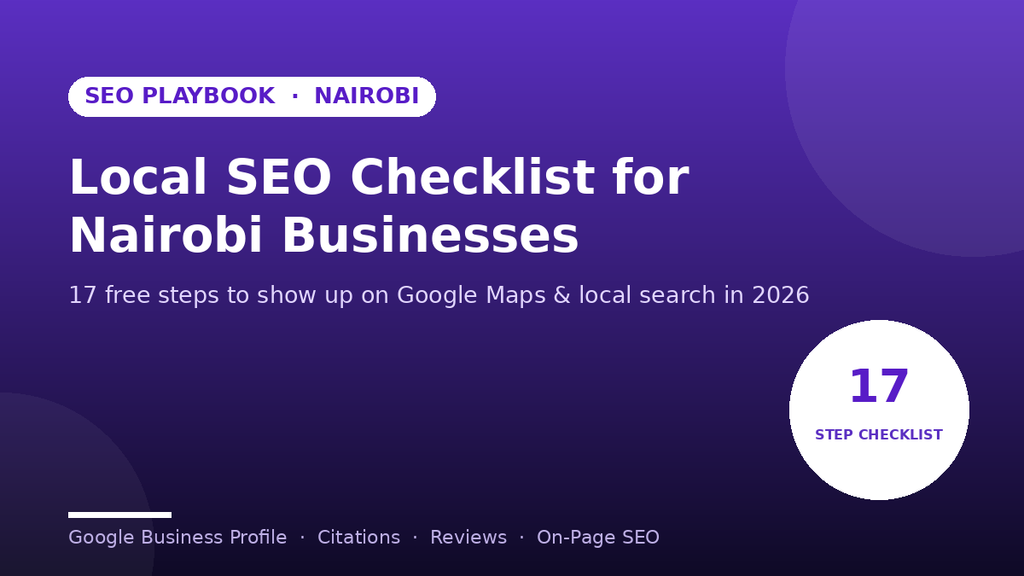
Local SEO Checklist for Nairobi Businesses If someone in Nairobi searches for a business like yours right now, does your business show up? For most small and medium businesses, the honest answer is “sometimes, and not near the top.” That gap is what local SEO closes.
Local SEO checklist, in practice, is the set of concrete, repeatable steps that get your business into Google’s local results — the map pack, the “near me” searches, the results people see before they’ve even decided who to call. It isn’t complicated, but it is detailed, and skipping steps is exactly why so many good Nairobi businesses stay invisible next to competitors with weaker products but stronger local SEO for small business fundamentals.
This is the checklist we run through for our own clients. Seventeen steps, grouped into five pillars, in the order we’d actually tackle them.
Table of Contents
- What Is Local SEO?
- Pillar 1: Google Business Profile
- Pillar 2: NAP Consistency
- Pillar 3: Local Citations & Directories
- Pillar 4: Reviews & Reputation
- Pillar 5: On-Page Local SEO
- A Simple 30-Day Local SEO Action Plan
- FAQs
(For the bigger picture — technical SEO, keyword research, and Core Web Vitals — see our full SEO for Kenyan Businesses guide. This post is the focused, local-only checklist.)
What Is Local SEO?
Local SEO is the practice of optimizing your online presence so your business appears in location-based search results — Google Maps, the local 3-pack, and “near me” queries — instead of only in generic organic listings. For any Nairobi business serving customers in person, it’s usually the highest-return marketing channel available.
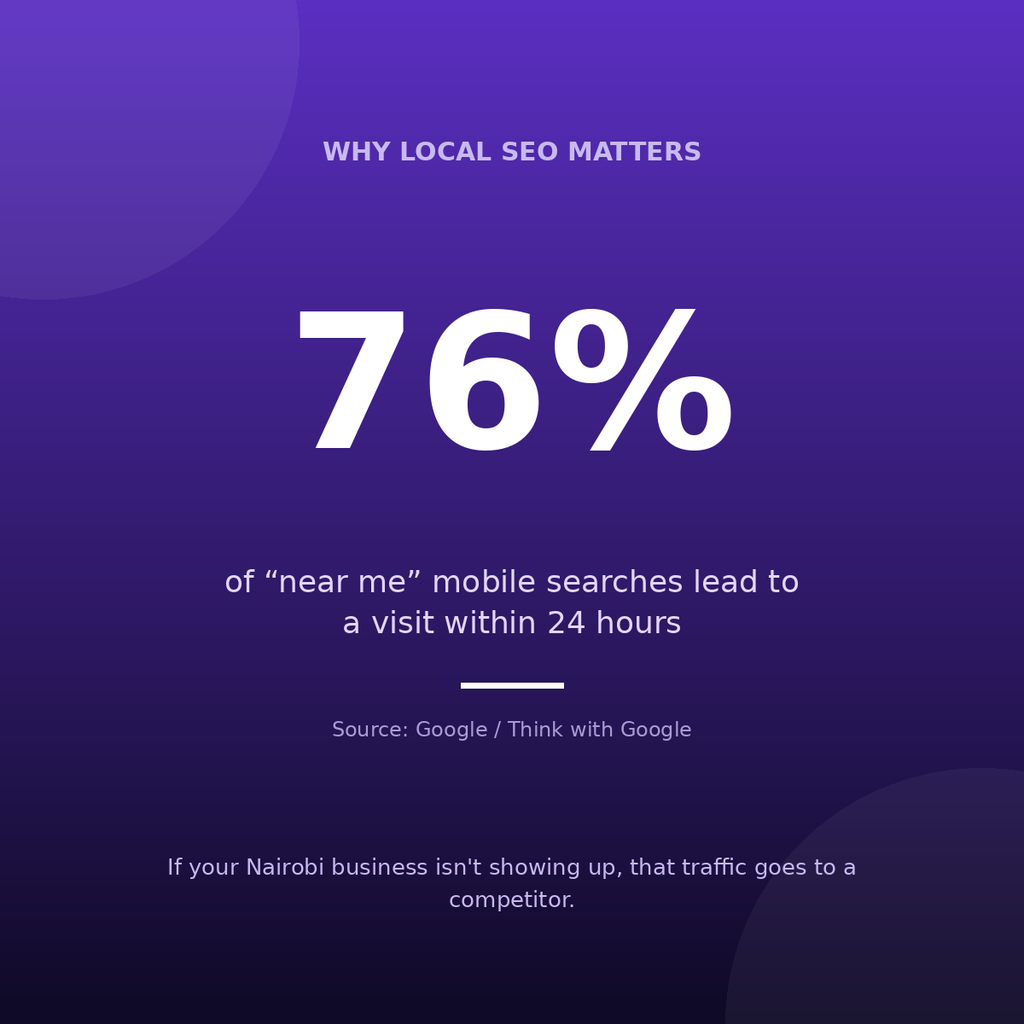
The numbers back this up. According to Google’s own research, roughly 46% of all Google searches carry local intent, and 76% of people who run a “near me” search on mobile visit a business within 24 hours. That’s an unusually fast path from search to sale — most marketing channels don’t come close.
It gets more specific once you look at what actually drives those visits. Google’s data shows that businesses with a fully completed Google Business Profile receive about 70% more location visits and are 2.7 times more likely to be seen as reputable than businesses with incomplete profiles. Reviews matter just as much — BrightLocal’s 2026 Local Consumer Review Survey found that 97% of consumers read reviews before choosing a local business, and 41% now say they always check reviews first.
Put simply: the businesses winning local search aren’t necessarily better businesses. They’re the ones that did the unglamorous setup work below.
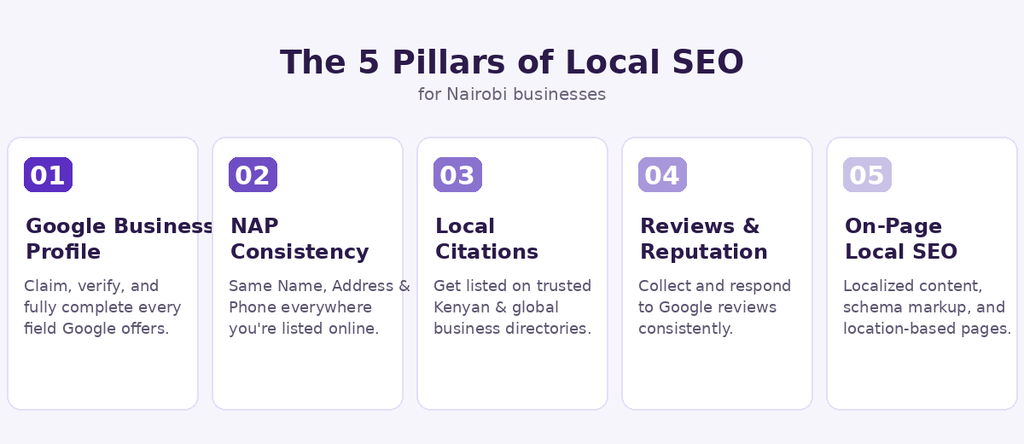
Pillar 1: Google Business Profile
Your Google Business Profile (GBP) — still commonly called “Google My Business” — is the single highest-leverage asset in local SEO. It’s free, and it’s what actually populates the map pack and the knowledge panel that shows up when someone searches your business name.
1. Claim and verify your profile. If you haven’t done this yet, it’s step zero — go to google.com/business, search for your business, and complete verification (usually by postcard, phone, or video, depending on category).
2. Choose your primary category carefully. Pick the single most accurate category first — “IT Support Company,” not the broader “Computer Store,” for example — then add relevant secondary categories. Category accuracy directly affects which searches you show up for.
3. Fill out every field Google gives you. Business hours, phone number, website, services list, attributes, and a written business description. An incomplete profile is the most common reason a business ranks below a less-established competitor.
4. Set your service area accurately. If you serve specific Nairobi neighborhoods — Westlands, Kilimani, CBD, Karen, or countywide — list them explicitly rather than leaving this vague.
5. Upload real photos, regularly. Storefront, team, work in progress, finished results. Profiles with recent, genuine photos consistently outperform those with none or with stock images.
6. Use Posts and answer Q&A. Google Posts (offers, updates, events) and the public Q&A section are both visible ranking and trust signals that most competitors leave empty — an easy way to stand out with minimal effort.
Pillar 2: NAP Consistency
NAP stands for Name, Address, Phone — and consistency here is one of the most overlooked local SEO for small business fundamentals. Google cross-references your NAP across the web to confirm your business is legitimate and current. Mismatches quietly undermine your rankings.
7. Standardize the exact format once. Decide on one exact way to write your business name, address, and phone number — including abbreviations (“Rd” vs “Road,” “+254” vs “0”) — and use that exact format everywhere.
8. Match it on your own website first. Your footer, Contact page, and schema markup should use the identical NAP format as your Google Business Profile. This is the easiest inconsistency to fix and the one most sites get wrong.
9. Audit and correct old listings. Search your business name and old addresses/phone numbers to find outdated citations — a former office, a disconnected number — and update or remove them.
Pillar 3: Local Citations & Directories
Citations are mentions of your business (with NAP details) on other websites. They function as trust signals — the more consistent, quality citations you have, the more confidently Google ranks you locally.
10. List on the major Kenyan directories. Start with Yellow Pages Kenya, BusinessList.co.ke, and Jiji Kenya, alongside Bing Places (Microsoft’s equivalent of Google Business Profile — often skipped, rarely competitive).
11. Add industry-specific directories where relevant. A hotel benefits from TripAdvisor and Booking.com; a professional service benefits from LinkedIn’s Company Page. Match the directory to your actual industry rather than listing everywhere indiscriminately.
12. Keep every citation updated. When you move offices or change your number, treat updating citations as part of the move checklist — not an afterthought discovered months later.
Pillar 4: Reviews & Reputation
Reviews influence both rankings and conversion directly. BrightLocal’s 2026 data found that 47% of consumers won’t consider a business with fewer than 20 reviews — a real threshold, not a vague preference.
13. Build a simple system to request reviews. Send a direct Google review link by WhatsApp or SMS right after a completed job or purchase, while the experience is still fresh. Don’t rely on customers remembering to do it unprompted.
14. Respond to every review. Positive or negative, a timely, professional response shows future customers — and Google — that the business is actively managed. Never ignore a negative review; address it calmly and take the conversation offline if needed.
15. Never buy or fake reviews. This violates Google’s policies outright and risks profile suspension. It also tends to backfire once customers notice a pattern of generic, implausible praise.
Pillar 5: On-Page Local SEO
The last pillar brings local relevance onto your actual website, reinforcing everything the first four pillars established off-site.
16. Use location-based keywords naturally. Work “Nairobi,” your specific neighborhood, and natural variations like local seo for small business into your title tags, headers, and body content — never forced or repeated unnaturally.
17. Add LocalBusiness schema and a dedicated location page. JSON-LD structured data (Rank Math can generate this) explicitly tells Google your business name, address, hours, and service area in a machine-readable format. Pair it with a Contact/Location page that includes an embedded Google Map — a small technical step that measurably helps local rankings.
A Simple 30-Day Local SEO Action Plan
If seventeen steps feels like a lot at once, here’s how to sequence it realistically over a month:
- Week 1: Claim/verify Google Business Profile, complete every field, upload photos (Pillar 1).
- Week 2: Standardize your NAP format and fix it across your website and top 5 citations (Pillar 2 & 3).
- Week 3: Set up your review request system and reach out to your last 10–15 customers (Pillar 4).
- Week 4: Add location keywords to key pages and implement LocalBusiness schema (Pillar 5).
From there, it’s maintenance: fresh GBP photos monthly, review requests ongoing, and a citation check every quarter.
FAQs
Is local SEO free? Mostly, yes. Google Business Profile, most Kenyan directories, and on-page changes cost nothing but time. The main cost is the hours spent doing it properly and consistently — which is exactly what agencies charge for.
How long does local SEO take to show results in Nairobi? Most businesses see initial movement in Google Business Profile visibility within 2–4 weeks of full optimization, with meaningful ranking improvement typically building over 2–3 months as citations and reviews accumulate.
Do I need a website, or is Google Business Profile enough? GBP alone can generate calls and visits, but a website adds schema markup, a location page, and content that GBP can’t provide — and it’s where Pillar 5 lives. For anything beyond a very small operation, both together outperform either alone.
What’s the difference between local SEO and regular SEO? Regular SEO targets ranking for a topic regardless of location. Local SEO specifically targets location-based intent — “near me,” neighborhood names, map pack results — and relies heavily on signals like GBP, NAP consistency, and reviews that standard SEO doesn’t touch.
Final Thoughts
None of these seventeen steps are individually difficult. What separates businesses that actually rank is doing all of them, consistently, and maintaining them — which is where most owners run out of time long before they run out of intention.
If you’d rather have this handled for you, this is exactly the kind of work we do for Nairobi businesses day to day. Get in touch about local SEO for your business →