
Call or Whatsapp +254795900573
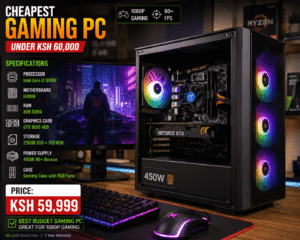

The Cheapest gaming PC in Kenya under KES 60,000 in 2026 come down to one honest trade-off: a genuinely solid esports-ready build with no discrete graphics card, or a tighter build that stretches to a basic dedicated GPU by cutting corners elsewhere. Here’s exactly what that budget buys, spec by spec.
Quick Comparison
| Build 1: Esports Starter | Build 2: Discrete-GPU Stretch | |
|---|---|---|
| Price range | ~KES 38,000–42,000 | ~KES 58,000–62,000 |
| Graphics | Integrated (Radeon Vega, on-CPU) | Entry discrete GPU added |
| Best for | Valorant, CS2, FIFA/eFootball, Dota 2, League of Legends | Slightly heavier titles, some AAA at low settings |
| RAM | 8GB DDR4 | 8GB DDR4 |
| Storage | 256GB NVMe SSD | 256GB NVMe SSD |
| Upgrade path | Add a discrete GPU later | Already near budget ceiling |
What Does KES 60,000 Actually Buy in Kenya Right Now?
Here’s the reality check most budget PC guides skip: a new, decent discrete graphics card alone — something like an entry-level 4GB card — typically costs KES 26,000–33,000 in Kenya on its own. Once you add a CPU, motherboard, RAM, storage, PSU, and case around that, a genuinely new-component build with a real discrete GPU pushes well past KES 60,000 before you’ve even added a monitor or peripherals.
That’s not bad news — it just means the smart move at this budget is knowing where to put your money. Modern AMD Ryzen “G-series” processors (like the Ryzen 5 5600G) ship with genuinely capable integrated Radeon graphics built into the chip itself, no separate GPU required. For esports titles — which is what most competitive Kenyan gamers actually spend their hours on — that integrated graphics performance is enough to run smoothly at 1080p. This is exactly why Build 1 below skips a discrete card entirely rather than pretending a token GPU addition would meaningfully help.
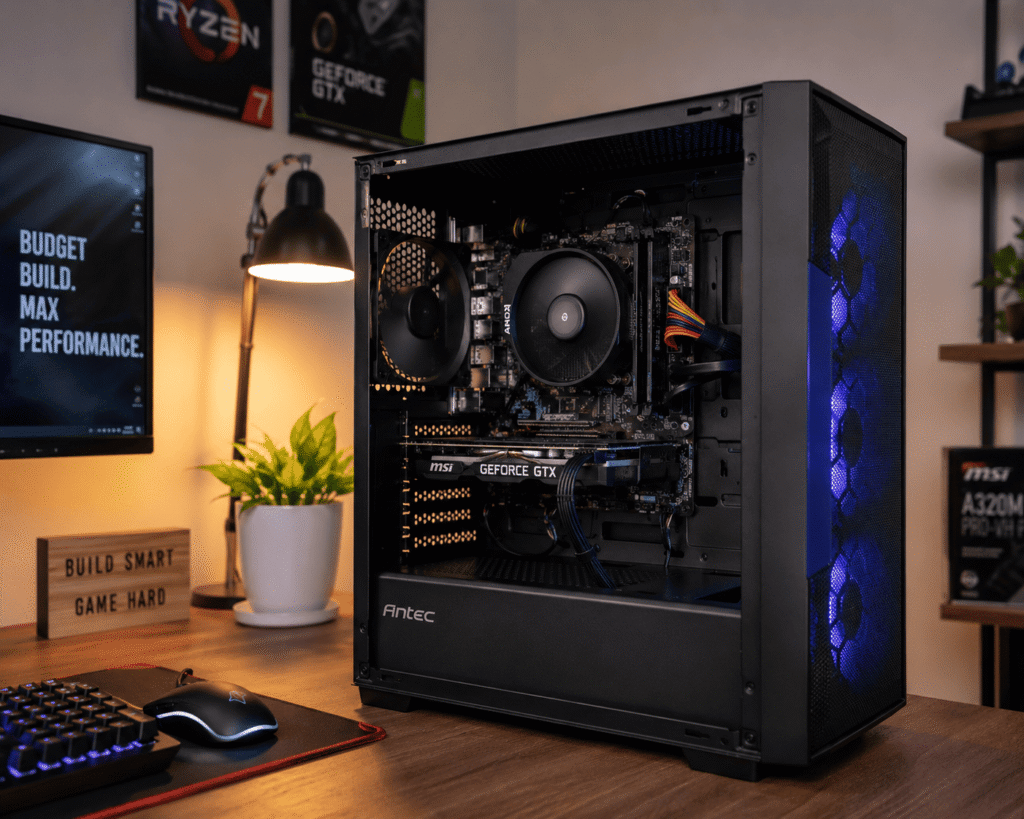
Build 1: The Esports Starter (~KES 38,000–42,000)
This build puts the entire budget into CPU, RAM, and storage quality rather than splitting it with a weak discrete GPU that wouldn’t meaningfully outperform the integrated graphics anyway.
| Component | Recommendation | Why |
|---|---|---|
| CPU | AMD Ryzen 5 5600G (integrated Radeon graphics) | Strong 6-core CPU with genuinely capable built-in graphics — no separate GPU needed |
| Motherboard | A520 chipset (AM4 socket) | Budget-friendly, all the connectivity this build needs |
| RAM | 8GB DDR4-3200 | The practical minimum for smooth modern gaming and multitasking |
| Storage | 256GB NVMe SSD | Fast boot and load times; enough for Windows plus several games |
| PSU | 450–500W | Comfortable headroom for this platform, with room to add a GPU later |
| Case | Budget mid-tower with basic airflow | Keeps temperatures reasonable without paying for RGB you don’t need |
What it handles well: Valorant, CS2, FIFA/eFootball, Dota 2, League of Legends, and most esports titles at smooth 1080p settings — genuinely the games most competitive Kenyan gamers are actually playing daily.
The upgrade path: Because this build already includes a proper PSU and A520 motherboard, adding a discrete GPU later (once budget allows) is a simple drop-in upgrade rather than a rebuild.
Build 2: The Discrete-GPU Stretch Build (~KES 58,000–62,000)
If you specifically want a dedicated graphics card at this budget, the honest path in Kenya’s market right now is the well-established secondhand/refurbished component market rather than buying a new discrete GPU — new cards simply eat too much of a 60,000 budget to leave room for a solid platform around them.
| Component | Recommendation | Why |
|---|---|---|
| CPU | Same Ryzen 5 5600G platform | Keeps integrated graphics as a fallback if the GPU ever needs replacing |
| Motherboard | A520 chipset (AM4 socket) | Same reliable budget foundation |
| RAM | 8GB DDR4-3200 | Kept lean here to make room for the GPU |
| Storage | 256GB NVMe SSD | Same fast, budget-friendly choice |
| GPU | A well-tested secondhand mid-tier card (e.g. RX 580 8GB class) | Genuinely capable of 1080p gaming in more demanding titles, at a fraction of new pricing |
| PSU | 500–550W | Slightly more headroom to safely run the added GPU |
| Case | Budget mid-tower with basic airflow | Same as Build 1 |
The trade-off to go in with eyes open: buying secondhand means inspecting or buying from a seller who tests the card in front of you and offers some form of guarantee — a small saving isn’t worth a GPU that dies in a month. If that feels like too much risk for your first PC, Build 1 is the safer, fully-new-parts option.
Prebuilt vs. Custom: Which Should You Choose at This Budget?
At the sub-60,000 tier specifically, custom builds generally win on value — prebuilt systems at this exact price point often cut corners on the power supply or use a case with poor airflow to hit a price target, since the margin has to come from somewhere. A custom build lets you see exactly where every shilling went. The exception: if you want zero research and zero waiting, a reputable local shop’s prebuilt at this tier can still be a reasonable choice — just ask specifically what PSU brand and wattage it uses before buying, since that’s the component budget prebuilds most often skimp on.
Where to Buy Components in Kenya
For individual components — RAM, SSDs, cases, and power supplies — Jumia is a genuinely convenient starting point for comparing prices and reading buyer reviews before committing, and it’s where a lot of Kenyan PC builders already start their research.
If you’d rather skip the research and part-matching entirely, that’s exactly what we do. Get a custom quote from us for a build in your exact budget — assembled, tested, and backed by a local warranty, not a box of parts you have to figure out yourself.
Common Budget-Build Mistakes to Avoid
- Skimping on the power supply. A cheap, unbranded PSU is the single riskiest place to cut corners — it’s the component most likely to damage everything else if it fails.
- Buying a discrete GPU that’s barely better than integrated graphics. If a “budget” dedicated card doesn’t clearly outperform a Ryzen G-series chip’s built-in graphics, you’ve spent money for no real gain.
- Forgetting Windows licensing costs. Factor this in before you commit to a component budget, or plan to use a Linux-based OS for a pure gaming-and-browser setup.
- Ignoring case airflow. A stylish case with poor ventilation will throttle a genuinely capable budget CPU under sustained load.
- Forgetting the monitor. These budgets assume you already have a display. A monitor genuinely matched to this tier — 1080p at 75Hz or higher — typically adds another KES 10,000–15,000, so factor it in before you finalise a total budget rather than discovering the gap after you’ve already bought the tower.
A Note on Longevity
Both builds here use the AM4 platform, which has been AMD’s mainstream socket for several generations now. That matters more than it sounds: it means a genuine, non-marketing upgrade path exists if your budget grows later — a better CPU, more RAM, or finally adding that discrete GPU to Build 1 — without needing to replace the motherboard. Buying into a well-supported platform, even at the entry tier, is usually a better long-term move than chasing the absolute lowest sticker price on a dead-end socket you’ll have to abandon entirely at your first upgrade.
Frequently Asked Questions
What’s the cheapest way to get a gaming PC in Kenya right now? An AMD Ryzen 5 5600G build with no discrete GPU, relying on its integrated Radeon graphics, is currently the most cost-effective genuine gaming PC option in Kenya — capable of smooth 1080p esports gaming for roughly KES 38,000–42,000.
Can I game without a graphics card in Kenya’s budget? Yes, for esports titles specifically. Modern AMD “G-series” APUs have integrated graphics strong enough for Valorant, CS2, and similar competitive titles at 1080p — a discrete GPU only becomes necessary for heavier AAA titles.
Is it better to buy a gaming PC on Jumia or build custom? Jumia is useful for comparing individual component prices, but a custom build — whether you assemble it yourself or have a local shop do it — typically gives better value than a fully assembled budget prebuilt at this price point, since prebuilts often cut PSU quality to hit a price target.
Should I buy a secondhand graphics card to stay under budget? It can be worthwhile if you buy from a seller who tests the card in front of you and offers some guarantee, since it’s the only realistic way to add real discrete graphics performance within a KES 60,000 total budget right now.
This build guide is part of our full Gaming in Kenya guide — check it out for PS5 pricing, mobile gaming, and the wider Kenyan gaming scene in 2026.
