Call or Whatsapp +254795900573
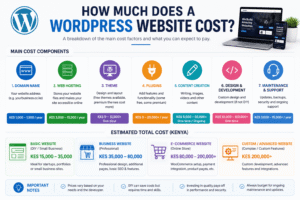

A WordPress website Cost in Kenya typically is anywhere from a few tens of thousands of shillings for a simple template-based brochure site to KES 130,000+ for a custom-built WooCommerce store — plus domain, hosting, and maintenance as ongoing costs. Here’s exactly where that money goes, tier by tier.
Quick Price Comparison
| Site Type | Typical Cost (KES) | What’s Included |
|---|---|---|
| Simple brochure site (5–8 pages) | 25,000 – 60,000 | Template-based design, basic pages, contact form |
| WooCommerce store, basic | 60,000 – 90,000 | Up to ~50 products, one payment gateway (M-Pesa) |
| WooCommerce store, standard | 90,000 – 130,000 | Multiple gateways, shipping logic, more products |
| Custom-built / complex site | 130,000+ | Bespoke design, custom plugins, complex functionality |
| Domain (annual) | 1,000 – 1,800 | .co.ke or .com registration |
| Hosting (annual) | 3,000 – 25,000+ | Shared hosting to managed WordPress hosting |
| Monthly maintenance | Varies by scope | Updates, backups, security monitoring |
What Actually Makes Up the Cost of a WordPress Website
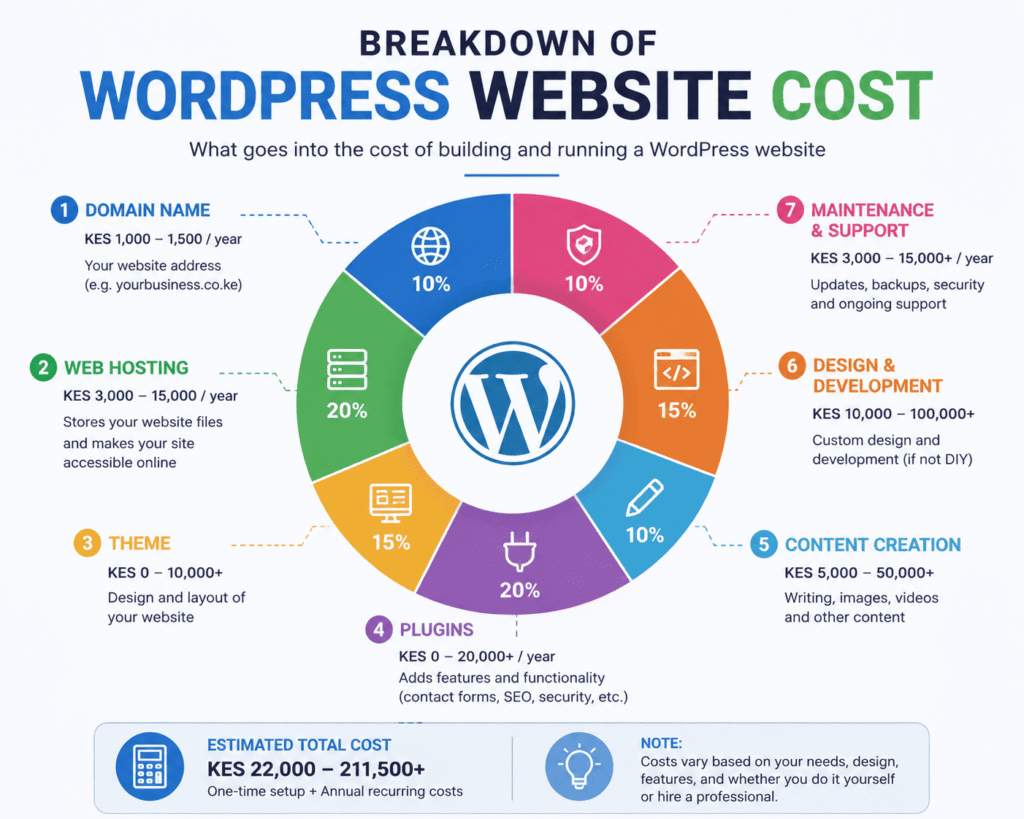
Breaking down WordPress website cost in Kenya into its real components is what actually lets you budget accurately, rather than comparing one confusing lump-sum quote against another. “How much does a website cost” is really five separate questions bundled into one:
- Domain registration — your web address (e.g., yourbusiness.co.ke), a small annual fee registered through a KeNIC-accredited registrar (the official body managing Kenya’s .ke domain space).
- Hosting — the server space that keeps your site live and accessible, billed annually or monthly.
- Developer fees — the actual design and build work, which is where most of the price variation lives.
- Theme or template licensing — free themes exist, but premium themes and page builders (like Elementor Pro) typically carry a one-time or annual license fee.
- Plugins — many essential ones are free; specialised functionality (advanced forms, specific WooCommerce extensions, SEO tools) sometimes carries its own cost.
Understanding which of these a quote actually includes is the single most useful thing you can do before comparing prices between developers — two quotes that look wildly different often turn out to be quoting different scopes entirely.
Tier 1: Simple Brochure Site (KES 25,000–60,000)
This covers a straightforward business site — home page, about, services, contact, maybe a gallery — built on a pre-made template rather than a fully custom design. It’s the right tier for a service business that mainly needs to establish credibility and be findable on Google, without needing to sell products directly through the site.
What pushes you toward the higher end of this range: more pages, a more heavily customised design within the template, or a developer handling your basic on-page SEO setup (title tags, meta descriptions, Google Search Console) as part of the build rather than leaving it to you.
Tier 2 & 3: WooCommerce Stores (KES 60,000–130,000+)
Once you need to sell products directly through the site, WooCommerce is almost always the right tool — and the cost scales with complexity rather than a flat rate:
- Basic WooCommerce setup (KES 60,000–90,000): up to roughly 50 products, one payment gateway — for most Kenyan businesses, that means M-Pesa integration via Safaricom’s Daraja API — and standard shipping settings.
- Standard WooCommerce setup (KES 90,000–130,000): multiple payment gateways, more sophisticated shipping logic (different rates for Nairobi vs. upcountry delivery, for example), larger product catalogues, and more customised product pages.
- Custom-built or highly complex sites (KES 130,000+): bespoke functionality that doesn’t come out-of-the-box — custom booking systems, membership areas, unusual product configurators, or integrations with external business systems.
The jump in price between tiers is almost always the M-Pesa/payment integration complexity and the amount of custom logic layered on top of WooCommerce’s defaults, not the number of products in your catalogue.
Template vs. Custom Build: Which Is Worth Paying More For?
This is the single biggest lever on price, so it deserves a direct answer: most Kenyan SMEs don’t need a fully custom design, and paying for one is often money better spent elsewhere.
A skilled developer working with a quality theme and a page builder like Elementor can produce a site that looks completely custom — because visually, the template is just a flexible starting point, not a rigid design you’re stuck with. Where a genuine custom build earns its higher price is specific, unusual functionality: something a page builder and existing plugins genuinely can’t do out of the box. If your business needs are fairly standard — showcase services, sell products, take bookings — a template-based build with a competent developer will look and perform just as well as a custom one, at a fraction of the cost.
Ongoing Costs Nobody Budgets For
The build price is a one-time cost, but a WordPress website has recurring costs that catch a lot of first-time site owners off guard:
- Domain renewal — roughly KES 1,000–1,800 per year, easy to forget until you get a “your domain has expired” notice.
- Hosting renewal — KES 3,000 on the low end for basic shared hosting, up to KES 25,000+ per year for higher-tier or managed WordPress hosting.
- Maintenance — updates, backups, and security monitoring. Whether you do this yourself or pay for a maintenance plan, budget real time or money for it; a neglected WordPress site is a security risk waiting to happen.
- Premium plugin or theme renewals — if your build uses any paid plugins or a premium theme license, most renew annually rather than being a true one-time cost.
A realistic annual “cost of ownership” for a basic site, beyond the initial build, typically lands somewhere between KES 5,000 and 20,000+ depending on hosting tier and how much maintenance you handle yourself.
Red Flags: Signs You’re Being Overcharged (or Underquoted)
A few warning signs worth watching for when comparing quotes:
- A quote with no breakdown at all. A single lump-sum number with no explanation of what’s included makes it impossible to compare against other quotes fairly.
- A price that seems too low for a WooCommerce store with payment integration. M-Pesa integration, testing, and proper checkout flow takes real development time — an unusually cheap quote for this scope often means corners will be cut on testing or security.
- No mention of hosting or domain at all. If a developer’s quote doesn’t clarify who’s paying for and managing these, you may end up with your own site locked into a hosting account you don’t control.
- No maintenance or handover plan. Ask directly what happens after launch — who updates plugins, who you call if something breaks, and whether that’s included or a separate ongoing cost.
Finding Reliable Website Developers in Kenya
Kenya has no shortage of web design companies and independent website developers, which is exactly why comparing quotes properly matters — capability varies enormously at every price point. A developer or agency worth hiring should be able to show you real, live examples of sites they’ve built (not just mockups), explain clearly what’s included in their quote, and be upfront about ongoing hosting and maintenance costs rather than leaving them as a surprise after launch.
If you’d rather skip the quote-comparison process entirely, that’s exactly what we do — transparent WordPress website cost in Kenya, itemised with no surprise fees after launch. Get a free quote for your WordPress website or explore our web development services.
Frequently Asked Questions
How much does a basic WordPress website cost in Kenya? A simple brochure-style site with 5–8 pages typically costs between KES 25,000 and 60,000, depending on design complexity and how much on-page SEO setup is included.
How much does a WooCommerce store cost in Kenya? A basic WooCommerce store with M-Pesa integration and up to around 50 products typically runs KES 60,000–90,000, rising to KES 90,000–130,000+ for multiple payment gateways, more complex shipping rules, or a larger catalogue.
Is it cheaper to use a template or build a custom WordPress site? Template-based builds are significantly cheaper and, for most Kenyan SMEs with fairly standard needs, look and perform just as well as a custom build. Custom pricing is only justified when you need genuinely unusual functionality a template and plugins can’t provide.
What ongoing costs should I budget for after my WordPress site launches? Domain renewal (roughly KES 1,000–1,800/year), hosting (KES 3,000–25,000+/year), and either your own time or a paid plan for updates, backups, and security maintenance.
Does the WordPress website cost include hosting and domain? Not always — this varies by developer, so ask explicitly. Some quotes bundle the first year of hosting and domain registration; others quote the build only and expect you to arrange hosting separately.
Why do WordPress website quotes vary so much between developers in Kenya? Mainly scope differences — what’s included (SEO setup, number of revisions, post-launch support), the developer’s experience level, and whether the quote covers a template-based build versus a fully custom one.
How do I choose between different website developers in Kenya? Ask to see live examples of similar sites they’ve built, get an itemised breakdown of what’s included, and confirm who handles hosting, domain, and post-launch maintenance before comparing final prices.
This pricing breakdown is part of our full WordPress for Kenyan Businesses guide — covering hosting, security, Elementor, and everything else you need to know before building.