Call or Whatsapp +254795900573

WordPress vs Wix vs Shopify. Every “WordPress vs Wix vs Shopify” article on the internet gives you the same generic answer: WordPress for flexibility, Wix for simplicity, Shopify for ecommerce. That’s true, but it skips the one factor that actually matters most for a Kenyan business choosing between them — how easily each platform lets your customers pay with M-Pesa.
This comparison covers the standard factors — cost, ease of use, scalability — but treats payment integration as the deciding factor it actually is for most businesses here, rather than a footnote.
Table of Contents
- The Real Difference Between the Three
- Quick Comparison Table
- M-Pesa & Payment Integration
- Ecommerce Features
- Cost Comparison
- Ease of Use
- Scalability
- Which Platform Should You Choose?
- FAQs
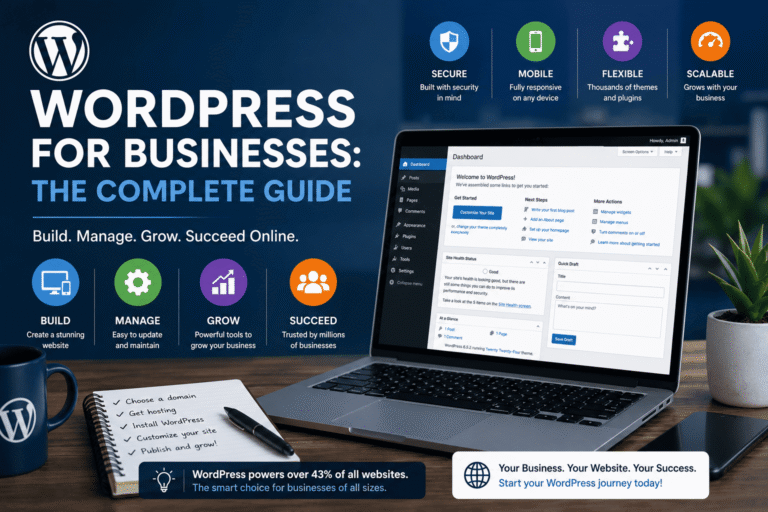
(For the full picture on building with WordPress specifically — themes, plugins, security, and maintenance — see our complete WordPress for Kenyan Businesses guide.)
The Real Difference Between the Three
WordPress is open-source software you install and control yourself, while Wix and Shopify are hosted platforms that handle the technical infrastructure for you — the trade-off is control and cost versus convenience. As a WordPress website builder, WordPress needs hosting and setup; Wix and Shopify bundle everything into one monthly subscription instead.
That flexibility is a big part of why WordPress remains the dominant platform globally. According to W3Techs’ CMS usage statistics, WordPress powers roughly eight times more websites than Shopify, its nearest competitor — a gap driven largely by its open plugin ecosystem, which is exactly what makes deep, Kenya-specific integrations like M-Pesa possible in the first place.
Quick Comparison Table
| WordPress | Wix | Shopify | |
|---|---|---|---|
| Type | Self-hosted CMS | Hosted website builder | Hosted ecommerce platform |
| Best for | Full control, content-heavy sites, WooCommerce stores | Simple sites, portfolios, small service businesses | Dedicated online stores |
| Ease of setup | Medium — more moving parts | Easiest — drag and drop | Easy, ecommerce-focused |
| M-Pesa support | Native plugins, often free | Via regional payment provider | Via third-party app |
| Ownership | You own everything | Locked into Wix’s platform | Locked into Shopify’s platform |
| Typical entry cost | Hosting + domain (~$3–10/mo) | From $29/mo for ecommerce | From $39/mo (Basic plan) |
M-Pesa & Payment Integration
For most Kenyan businesses, this is the section that should decide the whole comparison — everything else is secondary if customers can’t pay the way they actually want to.
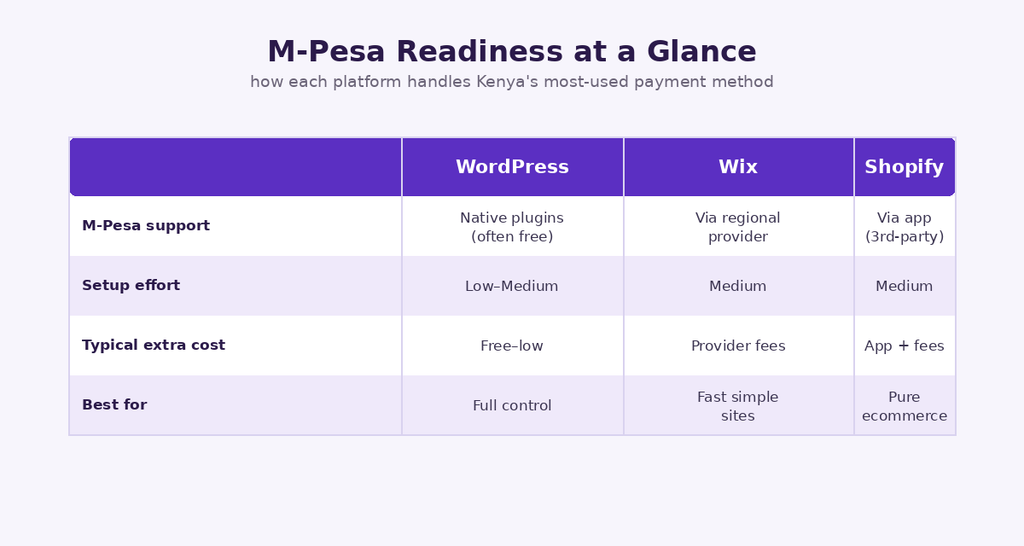
WordPress, via WooCommerce, has the most mature M-Pesa ecosystem of the three. There are multiple dedicated M-Pesa payment plugins, including a free official WooCommerce M-Pesa gateway on WordPress.org, alongside paid options from local providers like Pesapal and IntaSend. Setup typically means installing a plugin, entering your Paybill or Till number, and linking it to Safaricom’s Daraja API — well-documented and commonly done by Kenyan web developers.
Shopify has no native M-Pesa gateway. Shopify Payments, the platform’s built-in processor, isn’t available in Kenya at all, and M-Pesa doesn’t appear on Shopify’s own supported gateway list. Kenyan Shopify merchants work around this by installing a third-party payment app — IntaSend and Pesapal both offer dedicated Shopify apps — which adds an extra account, and sometimes extra fees, to the checkout flow.
Wix sits in between. Wix Payments also isn’t available in Kenya, but Wix supports regional third-party providers such as Peach Payments and SeerBit, which support Kenyan mobile money as part of a broader payment mix rather than M-Pesa specifically as a dedicated option.
The practical upshot: if M-Pesa at checkout is non-negotiable — and for most Kenyan businesses it should be — WordPress currently has the smoothest, cheapest path to offering it.
Ecommerce Features: WooCommerce vs Wix Stores vs Shopify
Beyond payments, the actual selling tools differ more than most comparisons let on.
WooCommerce (WordPress’s ecommerce plugin) is free and famously flexible — it’s the most-used ecommerce solution in the world, in part because it can be extended to do almost anything with the right plugin: subscriptions, bookings, wholesale pricing, multi-vendor marketplaces. The trade-off is that a lot of that power sits behind plugins you have to choose, configure, and keep updated yourself, or have a developer manage for you.
Shopify’s built-in store tools are more opinionated and polished out of the box — inventory, abandoned cart recovery, and multi-channel selling (social, marketplaces) all work without hunting for plugins. That polish is exactly why Shopify remains the default recommendation for a business that’s ecommerce-first and doesn’t want to manage technical infrastructure.
Wix Stores covers the essentials — product catalogs, discount codes, basic inventory — well enough for a small shop, but it’s noticeably less deep than either WooCommerce or Shopify once a store’s catalog or order volume grows. It’s the right fit for a business selling a modest, stable product range alongside an otherwise simple website.
For a Kenyan business specifically, this matters because WooCommerce’s plugin depth is also what makes the M-Pesa integrations, KES currency handling, and local shipping/courier plugins possible — the same openness that makes it more work to set up is what makes it more adaptable to a market Shopify and Wix weren’t originally built around.
Cost Comparison
Sticker prices are easy to compare; total cost is where the real difference shows up.
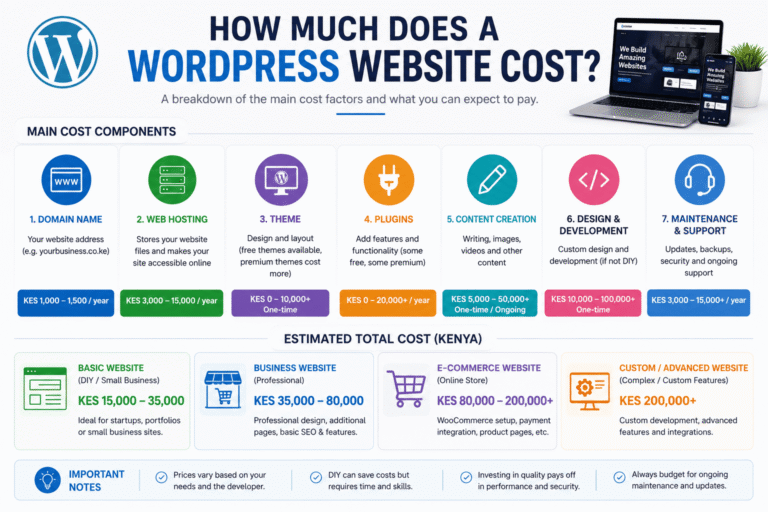
WordPress itself is free, but you’ll pay for hosting (from around $2–10/month on shared hosting — see our WordPress cost breakdown for Kenya for the full picture including domains, themes, and plugins), plus a domain and any premium plugins or themes you choose.
Wix’s cheapest ecommerce-capable tier, Core, runs $29/month billed annually according to Wix’s own pricing page, rising to $39/month on the Business plan for automated tax and expanded shipping tools. Hosting, SSL, and support are bundled in.
Shopify’s entry Basic plan costs $39/month billed monthly, or effectively $29/month on annual billing per Shopify’s pricing page, plus card processing fees on every sale (roughly 2.9% + $0.30 on Basic). Hosting and security are included.
For a simple brochure site, WordPress on cheap shared hosting is usually the lowest total cost. For a dedicated online store, the gap narrows once you factor in WordPress hosting built to handle WooCommerce properly, plus whichever payment app Shopify or Wix requires for M-Pesa.
Ease of Use
Wix wins outright here — it’s built for people with no technical background, with a visual drag-and-drop editor and templates that require no code to launch. Shopify is nearly as approachable specifically for ecommerce, with a more structured setup flow built around products, inventory, and checkout.
WordPress has a steeper initial learning curve. The dashboard, plugins, and themes give you far more control, but that control means more decisions — and more things that can be configured incorrectly by someone unfamiliar with it. This is exactly why WordPress site setup and maintenance is commonly outsourced to a developer or agency, while Wix and Shopify are more realistically DIY.
Scalability
This is where the platforms diverge the most long-term. WordPress scales as far as your hosting and development budget allow — from a KES 500/month shared plan to enterprise-grade infrastructure handling millions of visitors, with no platform-imposed ceiling on features or customization.
Wix and Shopify scale within their own ecosystems. Shopify in particular scales very well for ecommerce specifically, with plans reaching into enterprise territory (Shopify Plus). Wix is better suited to small and mid-sized sites; businesses that outgrow it typically migrate to WordPress or Shopify rather than a higher Wix tier.
Which Platform Should You Choose?
- Choose WordPress if: you want full ownership, plan to grow content or product range significantly, or M-Pesa integration at the lowest cost matters to you.
- Choose Wix if: you need a simple site live fast, have no ecommerce ambitions beyond basic sales, and value ease of use over flexibility.
- Choose Shopify if: your business is a dedicated online store first and everything else second, and you’re comfortable adding a payment app to handle M-Pesa.
FAQs
Which is cheaper for a small business in Kenya — WordPress or Shopify? WordPress is typically cheaper for a basic site, since hosting alone can cost a fraction of Shopify’s monthly fee. For a full online store, the gap narrows once WooCommerce hosting and any needed plugins are factored in.
Does Shopify support M-Pesa in Kenya? Not natively. Shopify Payments isn’t available in Kenya, and M-Pesa isn’t on Shopify’s supported gateway list — Kenyan merchants add a third-party app like IntaSend or Pesapal to accept it.
Is WordPress harder to use than Wix? Yes, initially. Wix’s drag-and-drop editor is built for non-technical users, while WordPress offers more control at the cost of a steeper setup process — which is why it’s commonly handled by a developer.
Can I switch platforms later if I start with the wrong one? Yes, but it takes real effort — migrating content, redesigning for a new platform, and reconfiguring payments and SEO. It’s worth getting the choice right the first time rather than planning to switch.
Final Thoughts
For most Kenyan businesses, this comparison comes down to one question more than any other: how much does frictionless M-Pesa checkout matter to you? If the answer is “a lot” — and for most Kenyan businesses it is — WordPress’s native payment plugin ecosystem gives it a real, practical edge that generic global comparisons never mention.
If you’re leaning toward WordPress and want it set up properly — hosting, WooCommerce, M-Pesa, and all — that’s exactly what we do. Get in touch about a WordPress or WooCommerce build →