Call or Whatsapp +254795900573


Understanding what a VPN for Kenyan business actually does — and why you need one right now — doesn’t require a technology degree. But it might require rethinking how your team connects to the internet every single day.
Whether your staff work from a Westlands office, a co-working space in Karen, or a café in Mombasa’s CBD, every device connecting to a public or shared network is a potential open door for cybercriminals. In this guide, we break down exactly what a VPN is, how it works in plain English, and seven specific situations where every Nairobi business owner should already have one active.
→ Already familiar with VPNs and just want a comparison? See our 5 Warning Signs Your Business Wi-Fi Has Been Hacked — and come back here when you’re ready to fix the problem.
What Is a VPN, Explained in Plain English?
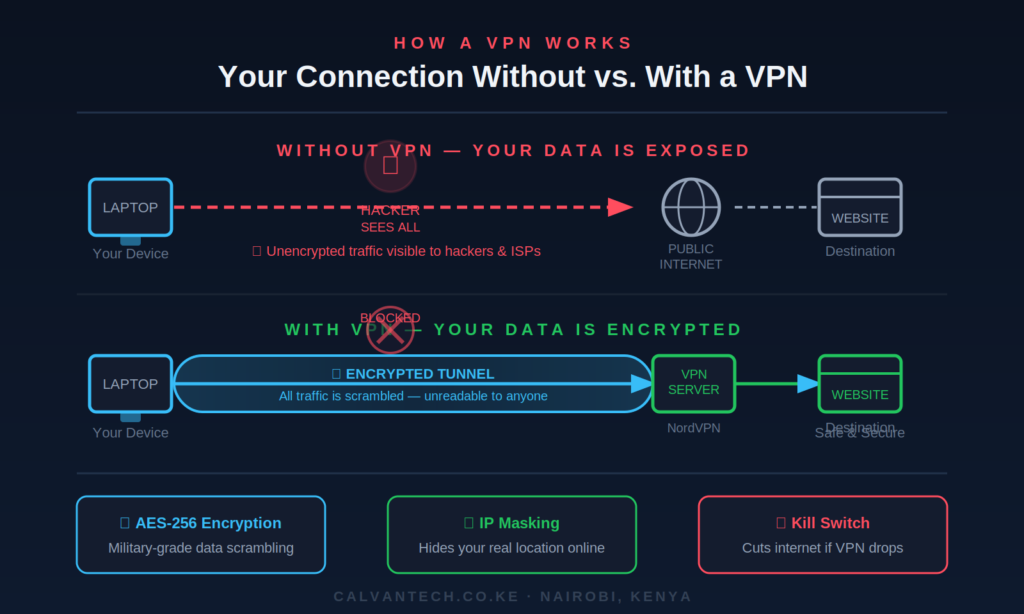
A VPN — Virtual Private Network — creates a private, encrypted tunnel between your device and the internet. Think of the normal internet as a busy Nairobi road where anyone standing on the pavement can see exactly what you’re carrying. A VPN is like an armoured courier van: the same journey, but no one outside can see what’s inside.
Here’s what actually happens when you turn on a VPN:
- Your device connects to a VPN server (NordVPN, for example, has servers in 100+ countries)
- All your internet traffic gets encrypted — scrambled into unreadable code — before it leaves your device
- Your real IP address (the digital label that identifies your location) is replaced by the VPN server’s IP address
- The website or service you’re visiting only sees the VPN server, not you
For a Kenyan business, this means everything your staff send and receive — emails, M-Pesa transaction data, client files, login credentials — travels through that encrypted tunnel instead of out in the open.
Why a VPN for Kenyan Business Is No Longer Optional in 2026
Kenya’s digital economy is growing fast — and so are the threats that come with it. Kenya’s National Cybersecurity Coordination Centre (KE-CIRT/CC) recorded over 3.3 billion cyber threat events in just the first three months of 2026. Most of those targeted the kind of network infrastructure — routers, remote connections, business servers — that a VPN directly protects.
There’s also a practical reality many Nairobi businesses don’t account for: your team’s connections outside the office are almost never as secure as the ones inside it. Every time a staff member checks their work email from a Safaricom hotspot, answers a client on a café’s free Wi-Fi, or accesses your accounting software from home, their connection is potentially visible to anyone on that same network.
Using a VPN for your Kenyan business closes that gap across every device, every location.
7 Situations Where Your Business Needs a VPN Right Now
1. Staff Working Remotely or from Home
Remote work didn’t disappear after 2020 — it became the default for many Nairobi businesses. But most residential Safaricom or Airtel home connections use basic router security that any determined attacker can probe. A VPN ensures your remote team’s connection to company systems is encrypted at both ends.
2. Connecting from Public Wi-Fi or Co-Working Spaces
Nairobi’s co-working spaces, hotel lobbies, and café hotspots are ideal for productivity — and ideal for attackers running “packet sniffing” tools that capture unencrypted traffic from everyone on the same network. A VPN makes that traffic invisible to them.
3. Accessing Your Banking, M-Pesa, or Payment Systems on the Go
This is the highest-risk scenario for Kenyan SMEs. Mobile money fraud is a real and growing threat — M-Pesa fraud reports have climbed sharply in recent years as transaction volumes increased. A VPN encrypts payment-related traffic, making it far harder for an attacker to intercept login credentials or transaction data.
4. Protecting Client and Customer Data
If your business stores or transmits customer information — personal IDs, contact details, purchase history — Kenya’s Data Protection Act 2019 requires you to take reasonable steps to secure that data. A VPN is a straightforward, documented control you can point to as part of your data protection measures.
5. Preventing ISP Tracking and Data Throttling
Your Internet Service Provider (ISP) can see every website your business visits and can throttle — slow down — specific types of traffic. A VPN encrypts your connection so your ISP sees only that you’re connected to a VPN server, not what you’re doing there. This can also improve speeds on connections that get throttled for streaming or large file transfers.
6. Giving Remote Employees Secure Access to Office Resources
Need a staff member in Mombasa to access a file server in your Nairobi office without opening that server to the entire internet? NordVPN’s Meshnet feature lets you create a private, encrypted network between your devices — effectively turning remote devices into trusted office connections without expensive enterprise hardware.
7. Travelling Internationally for Business
Kenyan business owners who travel frequently encounter Wi-Fi networks with varying security standards. A VPN gives you the same level of protection in a Dubai airport or a London hotel as you’d have in your own office, with a consistent Kenyan or local IP if you need to access location-restricted services back home.

What Does a VPN Actually Protect? (And What It Doesn’t)
Understanding the limits of a VPN is as important as knowing its strengths. Here’s a quick breakdown:
| A VPN PROTECTS YOU FROM… | A VPN DOES NOT REPLACE… |
|---|---|
| Snooping on shared/public Wi-Fi | Antivirus software (still need it for malware) |
| ISP tracking your browsing | Strong passwords and 2FA |
| Hackers intercepting data in transit | Keeping your router firmware updated |
| IP address tracking and geolocation | Physical device security |
| DNS hijacking (with Threat Protection on) | Employee security training |
A VPN is one layer of a strong security stack — not the whole stack by itself. For your business network and devices, it works alongside tools like Kaspersky for endpoint protection and proper Network Management.
Why We Recommend NordVPN for Kenyan Businesses
There are dozens of VPN services available in Kenya, and VPN use is completely legal here. But not all VPNs are built for business use, and free VPNs almost universally fall short in the areas that matter most: speed, privacy policy, and reliability.
After testing and recommending VPNs for our clients across Nairobi, NordVPN consistently comes out ahead for small and medium businesses. Here’s why:
Speed: NordVPN’s servers consistently deliver fast speeds even from East Africa. On a standard Safaricom home fibre connection during testing, speeds remained strong enough for video calls, cloud application access, and large file transfers — the three most common business use cases.
10 simultaneous devices: One NordVPN subscription covers up to 10 devices at the same time. For a small team — 3 laptops, 3 phones, a tablet, and a few other devices — that’s complete coverage under a single plan.
Threat Protection Pro: On the Plus plan and above, NordVPN’s Threat Protection Pro actively blocks malicious websites, trackers, and phishing links even when the VPN tunnel itself isn’t active. For staff who click links in emails, this is a meaningful extra layer.
Kill Switch: If the VPN connection drops unexpectedly, NordVPN’s kill switch cuts your internet connection instantly — so your real IP address is never accidentally exposed, even for a second.
Meshnet: Allows secure, encrypted peer-to-peer connections between your team’s devices, making remote access to office files possible without setting up a complex corporate VPN server.
Strict no-logs policy: NordVPN has been independently audited multiple times and operates under a verified no-logs policy — meaning they don’t store records of what you do online, even if law enforcement requests it.
Pricing in KES terms: NordVPN’s Basic plan on a 2-year subscription works out to around $3.49/month (~KES 450/month at current rates) — less than a single M-Pesa airtime top-up, for protection across 10 devices. The Plus plan, which adds Threat Protection Pro and a password manager, runs around $4.39/month on a 2-year plan. All plans include a 30-day money-back guarantee, so there’s no risk in trying it.
👉 Get NordVPN here and protect your business connections today
How to Set Up NordVPN for Your Business — It Takes 5 Minutes
Ease of setup is one reason NordVPN is particularly practical for Kenyan SMEs that don’t have a dedicated IT team:
- Sign up at NordVPN using the link above and choose your plan
- Download the app for your device — Windows, Mac, Android, iOS, and even Linux are all supported
- Log in with your NordVPN account credentials
- Choose a server — for Kenyan business use, South Africa servers often give the fastest speeds; for international access, select the relevant country
- Toggle on — the connection takes 2–3 seconds, and a small shield icon in your system tray confirms you’re protected
For teams, each staff member downloads the app and logs in with their own credentials on up to 10 devices. There’s no complex configuration required, and NordVPN’s 24/7 live chat support is available if you run into any issues.
If you’d like CalvanTech to manage your business VPN setup alongside your wider network security, our IT Support team can handle the full rollout and staff training.

Frequently Asked Questions
Is using a VPN legal in Kenya?
Yes — VPN use is completely legal in Kenya. There are no laws prohibiting businesses or individuals from using a VPN for privacy and security purposes.
Can a free VPN work for my Kenyan business?
Free VPNs are generally not suitable for business use. Most have strict data caps (often just 500MB–10GB per month), slower speeds, fewer server options, and — most importantly — many free VPNs generate revenue by logging and selling your browsing data, which defeats the entire purpose.
Will a VPN slow down my internet connection?
A well-chosen VPN like NordVPN has minimal impact on speed for normal business use — email, web browsing, video calls, and cloud applications. You may notice a slight increase in latency for very large downloads, but for most Kenyan SMEs this is undetectable in practice.
Do I need a VPN if I already have antivirus software?
Yes — they protect different things. Antivirus software scans files and programs on your device for malware. A VPN encrypts your internet traffic. Both together give you much stronger protection than either one alone. See our guide to Kaspersky for Kenyan businesses for more on endpoint protection.
How many devices can one NordVPN subscription cover?
A single NordVPN subscription covers up to 10 simultaneous connections, making it practical for small teams without needing multiple subscriptions.
Can my staff use NordVPN on their phones?
Yes — NordVPN has full-featured apps for Android and iOS. For a Kenyan business where staff frequently use phones to access M-Pesa business accounts and work email, enabling VPN protection on mobile is as important as on laptops.
Final Thoughts: Make the VPN Decision Simple
The decision to get a VPN for your Kenyan business in 2026 should be easy. The cost is low — KES 450 per month or less. The setup takes five minutes. The protection is immediate and covers every device on your team. And Kenya’s threat landscape makes the risk of going without one real and growing.
NordVPN is the option we recommend to our clients in Nairobi and across Kenya — for its speed, its reliability on East African connections, and its business-grade features at a price that makes sense for SMEs.
👉 Start protecting your business with NordVPN today — 30-day money-back guarantee