Call or Whatsapp +254795900573

IT support for Kenyan SMEs in 2026 isn’t a luxury — it’s risk management, since Kenya recorded 3.37 billion cyber threat events in the first quarter of 2026 alone. This guide breaks down managed IT, helpdesk support, network management, cybersecurity, cloud backup, and uptime — and exactly what a business your size actually needs.
Why IT Support Isn’t Optional for Kenyan SMEs Anymore
IT support for Kenyan SMEs has quietly gone from a nice-to-have to a core business function, and the numbers explain why. According to the Communications Authority of Kenya’s National KE-CIRT/CC, the country’s cybersecurity coordination centre, Kenya detected 3.37 billion cyber threat events in the first three months of 2026 — a slight decline from the 4.56 billion recorded the previous quarter, but still an enormous, sustained volume of attacks. Roughly 96% of these were system attacks: attempts to exploit vulnerabilities in network devices, operating systems, and databases. The Authority points to inadequate system patching, low cybersecurity awareness, and phishing as the main drivers, alongside a growing use of AI tools by attackers themselves.
This isn’t an abstract, big-company problem. Mobile money and fintech fraud remain among Kenya’s biggest digital risks, and smaller organisations — with limited budgets and lower security awareness — are consistently flagged as the most exposed segment. For an SME running WooCommerce, M-Pesa payments, or basic customer records on a shared laptop with no backup, a single successful attack can mean days of lost sales, lost customer trust, or in a worst case, lost data that never comes back.
Managed IT Services vs. Break-Fix Support
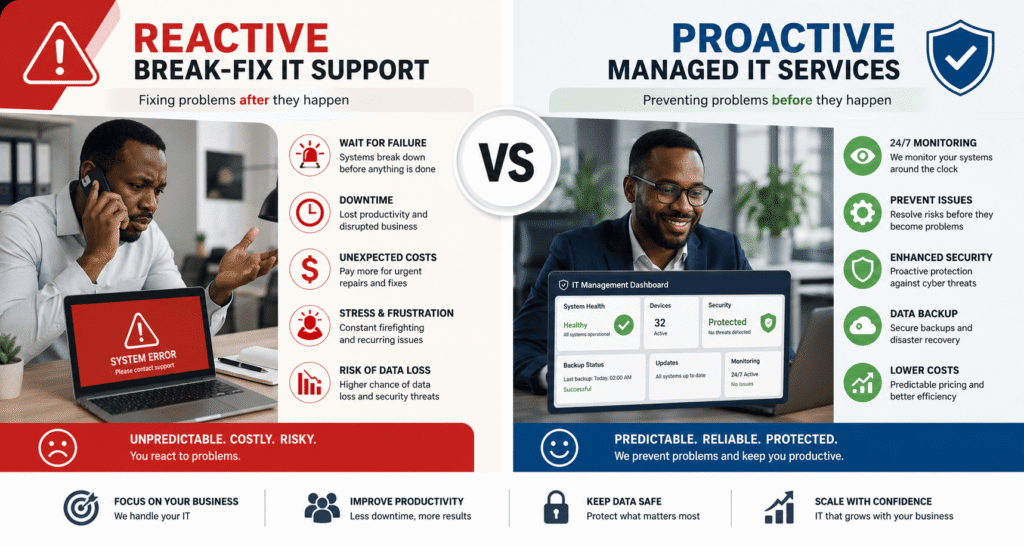
Most Kenyan SMEs start out on what’s called a “break-fix” model — you call someone when something breaks, pay for that one visit, and carry on until the next problem. It works, technically, but it’s entirely reactive: there’s no one watching for problems before they cause downtime, no structured patching schedule, and no incentive for whoever you call to actually fix the root cause rather than the symptom in front of them.
Managed IT services flip that model. Instead of paying per incident, you pay a predictable monthly fee for ongoing monitoring, maintenance, and support — the provider is incentivised to prevent problems rather than just respond to them, since fewer emergencies is the point, not more billable call-outs. For a growing Kenyan SME, this shift usually pays for itself simply by catching small issues (a failing hard drive, an expiring SSL certificate, an under-patched server) before they become expensive emergencies.
The honest trade-off is upfront cost versus long-term predictability. Break-fix looks cheaper on a slow month with no incidents, but it front-loads all your risk into whichever month something actually breaks — often at the worst possible time, since problems rarely wait for a convenient week. Managed IT trades that unpredictability for a flatter, more budgetable cost, which tends to suit growing businesses far better once there’s real revenue and customer trust at stake.
What a Good IT Helpdesk Actually Looks Like
A helpdesk is the day-to-day face of IT support — the point of contact when a printer won’t connect, an email account gets locked out, or a laptop won’t boot. A helpdesk arrangement that’s actually worth paying for should include:
- A clear way to log issues — a simple ticketing system or even a dedicated WhatsApp line, rather than hoping someone answers a personal phone number.
- Defined response times, even informally — knowing whether a critical issue gets addressed in an hour versus “whenever they’re free” matters enormously when your POS system is down mid-trading-day.
- Remote support as the default, with on-site visits reserved for hardware problems that genuinely need hands-on attention — this alone cuts resolution time dramatically for software and configuration issues.
- A record of recurring problems. If the same issue keeps coming back, a good helpdesk should eventually fix the underlying cause rather than repeating the same quick patch every time.
Network Management: Keeping Your Business Online
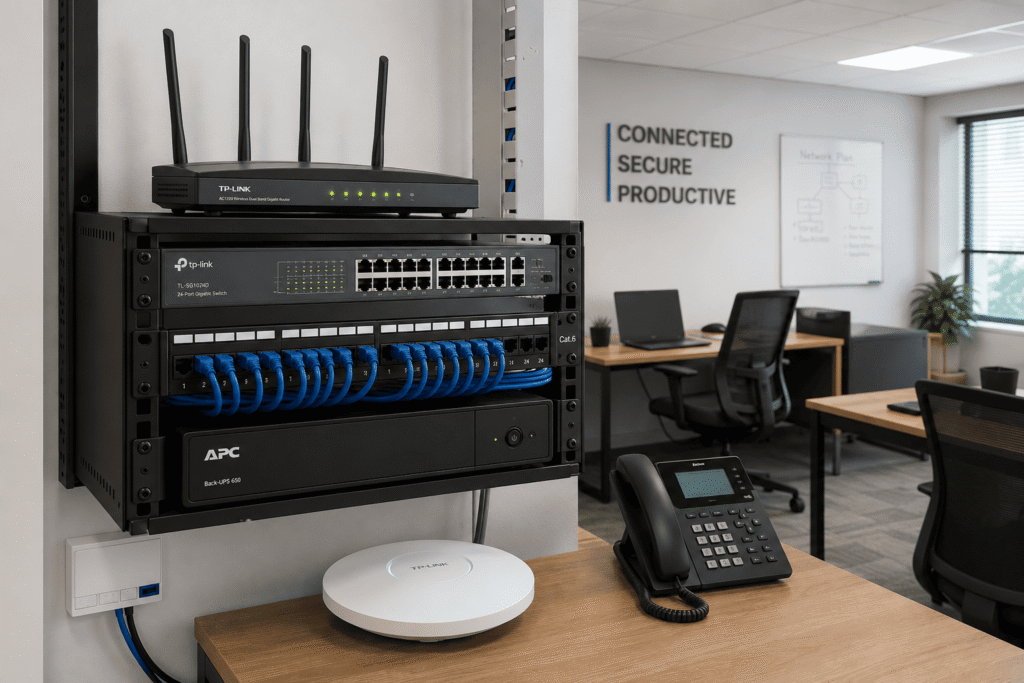
Network management covers everything that keeps your office or shop actually connected — routers, WiFi coverage, internet failover, and increasingly, secure remote access for anyone working outside the office. For most Kenyan SMEs, a few basics make an outsized difference:
- A business-grade router, not a consumer-grade one meant for a home living room — the difference shows up under real daily load with multiple devices and a POS system running simultaneously.
- A backup internet connection or failover, even a simple 4G/5G router as a fallback, so a single ISP outage doesn’t stop the business entirely — genuinely valuable in Kenya given how much day-to-day operation now depends on a live internet connection for M-Pesa, card payments, and cloud tools.
- A VPN for anyone accessing business systems remotely — encrypting that connection rather than leaving it open on public WiFi.
- Basic WiFi segmentation — keeping a guest network separate from the network your POS, accounting software, or customer database sits on, so a compromised guest device can’t reach anything sensitive.
Cybersecurity Essentials Every Kenyan SME Needs
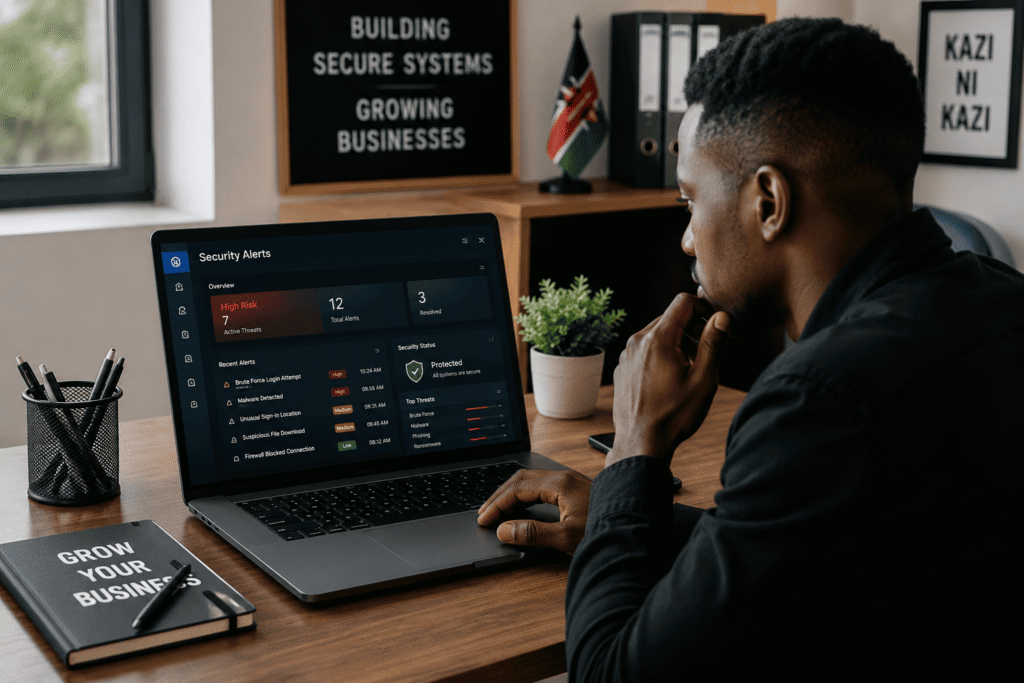
Given the sheer scale of threat activity the Communications Authority is tracking, cybersecurity for a Kenyan SME can’t be an afterthought bolted on once something goes wrong. The fundamentals that matter most, in rough order of impact:
- Multi-factor authentication everywhere it’s available — email, banking portals, cloud storage. This single step blocks the overwhelming majority of account takeover attempts, since a stolen password alone is no longer enough.
- A real antivirus/endpoint protection solution on every device that touches business data, kept updated automatically rather than manually. (We’ve reviewed several options suited to Kenyan SMEs on the blog — link to review post here.)
- A VPN for remote and mobile work, particularly for any staff handling customer or payment data outside a secured office network. (Link to our VPN comparison/review post here.)
- Regular, unglamorous patching — operating systems, plugins, and firmware updates, since the CA’s own reporting repeatedly names inadequate patching as a leading cause of successful attacks.
- Basic staff awareness training — most successful attacks start with a convincing phishing email or a social engineering phone call, not sophisticated hacking; a five-minute conversation about what a suspicious message looks like prevents more incidents than most technical controls.
Getting these basics right also matters for compliance: if your business handles customer data, the Data Protection Act, 2019 expects it to be processed securely, and a breach involving customer records carries both reputational and regulatory consequences.
Cloud Backup: Your Insurance Policy
Backup is the one IT investment nobody regrets and almost everybody underinvests in — until the day a laptop is stolen, a hard drive fails, or ransomware locks every file on a shared computer. A sound backup approach for a Kenyan SME follows a simple structure:
- At least one copy stored off-site or in the cloud, so a fire, theft, or hardware failure at your physical location doesn’t also destroy your only backup.
- Automatic, scheduled backups, not something that depends on a staff member remembering to plug in a USB drive.
- Periodic restore tests — a backup nobody has actually tried restoring from is an assumption, not a safety net. This is the step most businesses skip, and the one that matters most.
For anything running on WordPress specifically — your website, your WooCommerce store — this pairs directly with the hosting and backup guidance in our WordPress for Kenyan Businesses guide.
Uptime & Why It’s the Metric That Actually Matters
Uptime — the percentage of time your systems are actually available and working — is the single number that best captures whether your IT support is doing its job. It’s easy to overlook until an outage happens mid-transaction, and then it’s the only thing that matters.
A few practical points on uptime for a Kenyan SME:
- 99.9% uptime still means roughly 8-9 hours of downtime a year — “three nines” sounds impressive but isn’t the same as “never goes down.” Know what level your provider is actually promising, if any.
- Proactive monitoring catches problems before customers do. A managed IT provider watching server health, disk space, and network status can often resolve an issue before it causes a visible outage at all.
- Not every system needs the same uptime target. Your customer-facing POS or e-commerce checkout deserves far more redundancy investment than, say, an internal filing system that can tolerate a short outage without costing you sales.
Rather than chasing a single uptime number across the whole business, it’s usually more useful to rank your systems by how much a disruption actually costs you, and put your redundancy budget where a failure would hurt most.
What Should an IT Support Plan Actually Include?
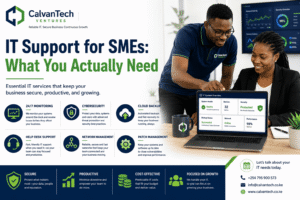
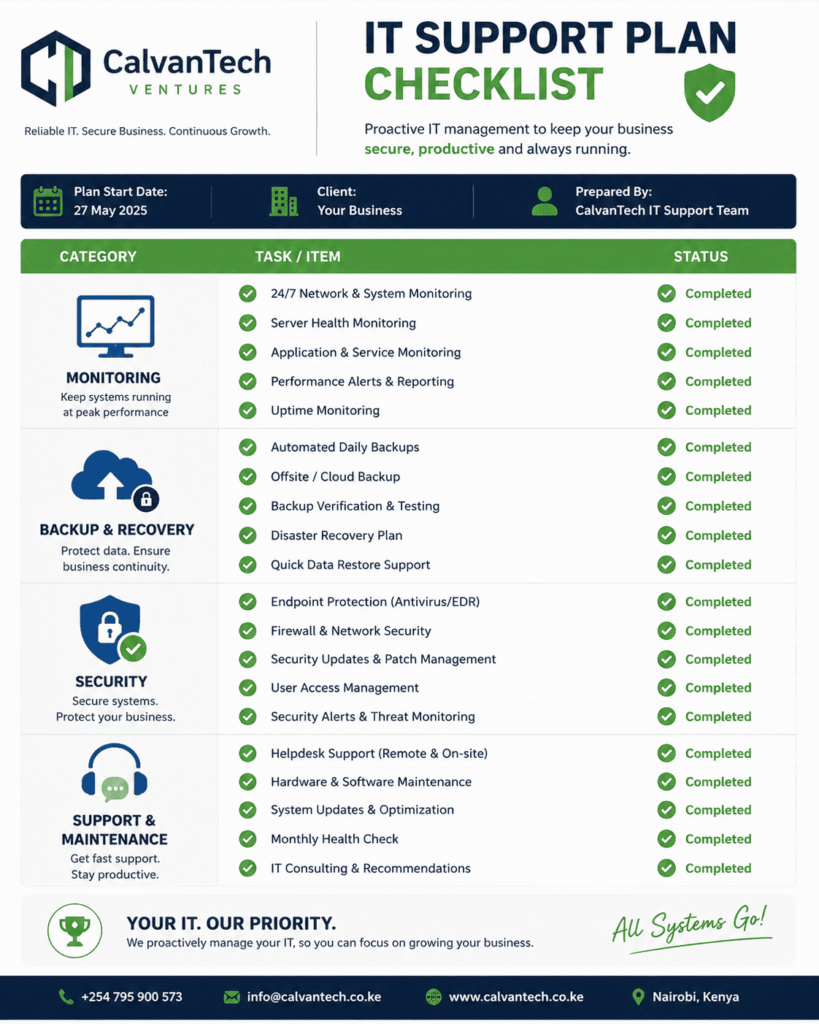
Pulling the sections above together, a genuinely useful IT support plan for a Kenyan SME typically covers:
- Proactive monitoring and patch management across all business devices
- A responsive helpdesk with clear escalation for urgent issues
- Network management, including business-grade WiFi and failover internet
- Endpoint security (antivirus/EDR) and multi-factor authentication across accounts
- Automated, tested cloud backup for both devices and any WordPress/WooCommerce assets
- Regular, plain-language reporting so you actually know what’s being done and why
Anything missing one or more of these isn’t really a complete IT support arrangement — it’s a partial one with a gap waiting to become an expensive problem.
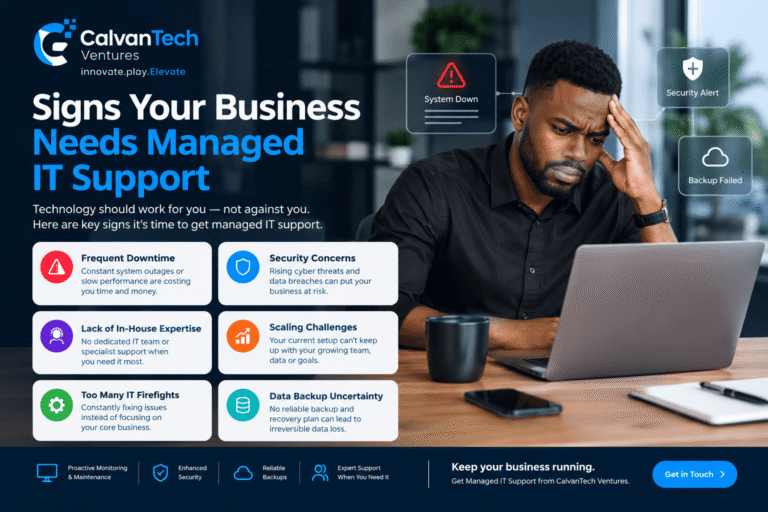
Signs Your Business Needs Managed IT Support Now
A few honest signals it’s time to move beyond ad-hoc, break-fix support:
- You’ve had a data-loss scare — a crashed laptop, a corrupted file, a “wait, do we actually have a backup of that?” moment.
- The same technical problem keeps recurring without ever being properly fixed.
- Nobody in the business can say with confidence when your last backup actually ran, or whether it would restore correctly.
- You’re growing past a handful of staff and devices, at which point informal, ad-hoc fixes stop scaling.
- You handle customer payment or personal data and have never had a real look at your security posture.
If more than one of these sounds familiar, the cost of proper IT support is very likely lower than the cost of the incident it would have prevented.
Getting Professional Help
If you’d rather have a dependable team handling this than manage it all in-house, that’s exactly what we do. Check out our managed IT and support services or get in touch for a free consultation on what your business actually needs.
Frequently Asked Questions
Do small businesses in Kenya really need managed IT support? Given that Kenya recorded 3.37 billion cyber threat events in Q1 2026 alone, with SMEs consistently flagged as the most exposed segment due to limited budgets and awareness, yes — proactive IT support is increasingly a risk-management necessity rather than a luxury.
What’s the difference between managed IT services and break-fix support? Break-fix support means paying per incident after something breaks, with no ongoing monitoring. Managed IT services charge a predictable monthly fee for continuous monitoring and maintenance, with the incentive structure aimed at preventing problems rather than billing for repeated emergencies.
How much downtime is “acceptable” for a small business? There’s no universal answer — it depends on which system is affected. A customer-facing checkout or POS system justifies far more investment in uptime than an internal tool that can tolerate an occasional short outage.
Is cloud backup really necessary if I already save files on my computer? Yes. A local-only backup doesn’t protect against theft, fire, hardware failure, or ransomware affecting the same device. A genuine backup strategy includes an off-site or cloud copy, ideally tested periodically to confirm it actually restores.
What’s the single highest-impact security step a small business can take? Enabling multi-factor authentication on email, banking, and cloud accounts blocks the vast majority of account takeover attempts and costs nothing beyond a few minutes of setup per account.
How do I know if my business needs a VPN? If any staff member accesses business systems, customer data, or payment platforms while outside the office — including over public WiFi — a VPN encrypts that connection and is a low-cost, high-value addition to your security setup.
Final Thoughts
IT support for Kenyan SMEs in 2026 comes down to a straightforward trade-off: a predictable, proactive monthly investment versus an unpredictable, often much larger cost when something eventually goes wrong. Given the scale of cyber threat activity Kenya is currently seeing, “wait until it breaks” is no longer a strategy most businesses can afford to run on. Start with the basics — backup, multi-factor authentication, and a responsive helpdesk — and build from there.